Saturday, June 26, 2010

"Daughter of McLean's Newspaperman"


I was asked to talk at the Centennial Celebration of McLean, Virginia, about being the daughter of "McLean's newspaperman." That would be my father, Bill Elvin, owner, editor and publisher of a weekly, the McLean Providence Journal, for 30 years. Here's what I said about that:

Dad was an old-fashioned, "shoe-leather reporter." He loved writing and publishing news about McLean up until the very last.

The hallmarks of his work were integrity, fairness, and honest reporting without embellishment or editorializing.

He knew from early on that he wanted to be a reporter. While attending the University of Michigan, he was assistant editor of the Michigan Daily. During World War II, he served in General Patton's Third Army — they met the Russian Army at the end of the war in Austria. Dad was selected Designated Vodka Drinker by his company for the occasion, and was interviewed by a reporter for Izvestia. (I never got whether the interview took place before or after the vodka.)

After the war, he worked for the Washington Star for ten years, then decided to venture out on his own and bought the Providence Journal from Richard M. Smith. Some people called the paper under Smith a gossip sheet that served as a vehicle for Smith's extreme segregationist views, which couldn't have differed more from my father's. Dad charted his own way, steering away from editorial opinion, given "the facts, just the facts," and trusting the readers to form their own conclusions.

He intended to paper to be a local McLean paper from the very beginning. When he took over, paid circulation was about 2,000. He sharply reduced coverage of communities outside of McLean, losing about half the subscribers. But the additional news of McLean eventually won over new readers, and the circulation went to 2,000 and beyond.

The Providence Journal covered local fairs, back-to-school, holidays, elections, and material for columns such as In the Services and In the Colleges. He appreciated the unintended compliment from a reader that went, "I do not like your paper and am re-subscribing only for purposes of information."

Once when I attended a joint McLean-Marshall High School reunion, I noticed that in one of the suites alumni used to bring out old photos and memorabilia, clippings from the Providence Journal were laid out on table in abundance, yellowed by time. A glorious moment for one boy at a football game, a notice of enlistment of another, accomplishments, moments of their lives all noted in their local paper. When I told Dad, he was so pleased. He said emphatically, "That's what I always wanted it to be. The hometown newspaper."

Dad had acute powers of observation. I remember one afternoon as he mowed our lawn, he noticed a car parked on our street. It was unusual for anyone to park there, since the street was narrow and all the houses had long driveways. When he saw the car, he jotted down the license plate number — he was never without pen and paper, even doing yard work. Detectives appeared a short time later, fanning out to investigate an incident in the neighborhood. When they saw my father in the front yard, they approached him and asked if he'd seen anything out of the ordinary that day.

He told them about the car and in his understated manner, pulled out his notepad, read off the plate number, gave the model, year and color of the car, and the exact time of day he'd seen it. With that information, the detectives were able to send out an APB. Soon enough, a suspect was apprehended on the Beltway and was subsequently convicted of raping a teenaged girl who lived up the street.

In February of 1958 a double snowstorm prevented him from delivering the papers from the printshop to the post office for mailing. The snow was deep and blinding, and high winds created whiteout conditions. At the last moment, two young women on horseback rode up the rode toward the printshop and offered to take the papers on horseback. Saved by the Pony Express! [You can read the further details of this in my March 6 blog, below.]

I can remember driving from McLean to Oakton to the old print shop where the Providence Journal was churned out once a week in the olden days. It was one shack tacked onto the other. The floors were dirt, the presses were noisy, it was dark, and it smelled of printers' ink. All the men who worked there seemed covered in ink. And Dad loved that part of the weekly newspaper routine just as he loved all aspects of being editor, publisher, chief reporter, owner, and chief cook and bottle washer of the Providence Journal.

Things of course modernized and changed, but what never changed was his love of reporting or his integrity. By his example he taught me a great lesson: doing something for a living that you love and that is meaningful matters much more than money or satisfying someone else's wishes.

The picture shows my father a little over 50 years ago, trying to get some work done. My brother George is helping.

Wednesday, May 19, 2010

The Best Years of Our Lives — a great movie about war


The Best Years of Our Lives is an American classic, directed by William Wyler and produced by Samuel Goldwyn in 1946. The film, which won seven Oscars, shows a depth of insight about the psychological impact of war on the returning soldier that surprised and touched me. Set in a small town in post-World War II America, the movie tracks three men who have served overseas, and blends their stories upon homecoming. Each is excited that the day has finally arrived, but anxious as well. The bombadier played by Dana Andrews comments as they approach their fictitious hometown of Boone City, that they are all "...nervous out of the service."

Talented actors are featured such as Dana Andrews, Fredric March, Myrna Loy, and Teresa Wright, among others. Harold Russell, an actor who had served in the Pacific, played Homer. Russell had lost both hands during a training accident. Some of the movie's most poignant scenes occur between Homer and his childhood sweetheart, Wilma, as they struggle to adjust to his war wounds. Wilma's the brave soldier here - she never wavers in her love for Homer when he nearly gives up, unwilling to burden her with the challenges he will face in life. The three men tried to cope with the conflicts, changes, losses and awkward situations they face upon their homecoming.

I thought of my father and mother and wondered about their reunion after the war as I watched Myrna Loy's and especially Fredric March's understated and honest portrayals. Wonderful acting shines through, such as when Loy realizes that it is her husband whom she hears coming in the front door after years of separation. You can almost see it in the change in her posture —
it's a profound moment.

For cinema buffs, the movie features deep-focus cinematography made popular by Orson Welles and his cinematographer in
Citizen Kane. In deep-focus, the foreground, middle-ground and background are all in focus. Notice this in the famous "long hallway homecoming" shot.

The photo comes from Nell Minow's Movie Mom blog/

Wednesday, May 12, 2010

Mesothelioma and veterans


If you are a veteran, you should familiarize yourself with the Mesothelioma Center. Mesothelioma is a life-threatening illness that usually results from exposure to asbestos. According to the Center's website, if you served between 1940 and 1970, you face a greater risk of developing this disease or other asbestos- related illness.

Asbestos has been commonly used in military applications, products and ships, primarily because of its resistance to fire. The Center will provide a list of occupations, ships, and shipyards that could have put veterans at risk for this disease. Since asbestos-related disease is not always recognized by the VA, compensation can be difficult to obtain. The Center will provide benefit counselors to help guide you through the process of filing a VA claim at no charge. Their job is to help any veteran obtain the maximum benefit to which he or she is entitled.

Ben Grayson is the Veterans Liaison for the Mesothelioma Center.

Friday, April 16, 2010

Honoring the Liberators


This week marked the commemoration of the National Days of Remembrance at the U.S. Holocaust Memorial Museum in Washington. Some 120 World War II veterans in their 80s and 90s, wearing tags that said "LIBERATOR," came to be together, to be honored, and to remember.

I am familiar with the story of the liberation of Ebensee, Austria, where soldiers from the 3rd Cavalry Reconnaissance Squadron had done advance scouting for the 80th Infantry Division and discovered the camp while the chimneys were still smoking from the burning of bodies. It was filled with piles of the dead and emaciated, dazed prisoners.

As an officer in the 80th, my father had gone to see the newly liberated concentration camp at Ebensee. He later said that, "In a way, it was worse than combat. I saw wounded in combat, of course, who were in terrible shape, but this was really bad. The smell of it was so overpowering....I didn't know why I'd come. I was sorry I had. It was so devastating, so depressing. Frightening, really."

Annie Gowen, writing for the Washington Post last Thursday, April 15, in an article titled, Remembering the Atrocities of World War II, wrote about Army nurse Dorothy Pecora, now 90 and living in McLean, Virginia, near Washington. Ms. Pecora brought photos to the Museum that she had carefully preserved, and she spoke of the prisoners she tended at Ebensee. I immediately thought of Lieutenant Jeannie Davis, another Army nurse whom I interviewed for my book. They may well have been in the same unit, the 139th Evacuation Hospital. Here's what I wrote in my book when I interviewed Davis:

Her job, along with the doctors and medical technicians, was to get the inmates ready to evacuate to a regular hospital. The men went up to the camp first but a full week passed before they allowed the nurses to go....

When we did go to the camp, and when I think of this, it was so idiotic — we took tablecloths up there. We thought we would try to make it pleasant for them. They had old wooden tables and they were bringing up better food for them. Of course, they were starving to death. They were in bunks, and they were still lying there, many of them dead. Every five minutes somebody would die, even weeks after liberation. It was so awful and there we were, these silly little nurses, putting tablecloths around.

But it didn't shock us as much as others who were not nurses. Through our training, we'd seen everything. The fact that it was done deliberately, in such mass, was what made it different. But we were able to talk to them and stand next to the bunks. I can think of women I know who couldn't possibly have done that, but we could.


Her humility, courage and confidence come through in those comments. I think the nurses are really the unsung heroines of wartime.

As I read through Gowen's article yesterday, it struck me that Dorothy Pecora, from McLean, Virginia, may well have crossed paths with my father. Since he lived in McLean himself for nearly fifty years, perhaps they stood next to one another in the line at the grocery store or the post office. Maybe they chatted about the weather or the rising price of postage, without ever knowing they shared this awful piece of history.


The arch marks the entrance to what remains of the camp at Ebensee. Houses have been built where the camp stood.

Sunday, March 21, 2010

The Old Liberators


by Robert Hedin

Of all the people in the mornings at the mall,
It’s the old liberators I like best,
Those veterans of the Bulge, Anzio, or Monte Cassino
I see lost in Automotive or back in Home Repair,
Bored among the paints and power tools.
Or the really old ones, the ones who are going fast,
Who keep dozing off in the little orchards
Of shade under the distant skylights.
All around, from one bright rack to another,
Their wives stride big as generals,
Their handbags bulging like ripe fruit.
They are almost all gone now,
And with them they are taking the flak
And fire storms, the names of the old bombing runs.
Each day a little more of their memory goes out,
Darkens the way a house darkens,
Its rooms quietly filling with evening,
Until nothing but the wind lifts the lace curtains,
The wind bearing through the empty rooms
The rich far off scent of gardens
Where just now, this morning,
Light is falling on the wild philodendrons.


Saturday, March 6, 2010

Snowstorms and newspaper delivery — on horseback


Two hot topics in the news lately: first, talk of the United States Postal Service cutting back on delivery, and, second, in case you haven't heard yet —we had record snowfalls in our area. These two things bring to mind a story my father told about his days as editor and publisher of a small weekly newspaper in McLean, Virginia, the McLean Providence Journal.

It was a February 1958 snowstorm that dropped 14" of snow on Northern Virginia. The storm resulted in massive snowdrifts, whiteout conditions, and high winds. Transportation was paralyzed, and power was lost for a week.

The newspaper was printed at a country print shop near Oakton, Virginia. Even after Dad was able to reach the shop through the snow from the newspaper office in McLean, there was no electricity to turn the press. The print shop foreman, Earl Mutersbaugh, loaded the metal forms into his car and took them to the print shop at the Manassas Messenger, a distance of thirteen miles. The flat sheets were returned, having been printed, to Oakton, finally ready for folding and mailing. Then the second snowstorm descended.

Just when it looked as though some $2000 worth of advertising was going to be lost forever, two young women trotted up the road on horseback. After they were told about the delivery problem, they asked if they could help. Eagerly, the print shop people loaded the papers into their saddle bags. The two brave horsewomen headed off into the blinding snow toward the Oakton Post Office several miles away, saving the day.


My father, Bill Elvin, at his desk in the newspaper office.

Monday, February 1, 2010

February 4, 1945 — Luxembourg


I turned the page of the calendar from January to February this morning and as I did, I recalled that sixty-five years ago this Thursday my father returned to combat after nearly three months in the hospital.

It was February 4, 1945 when 1st Lt. Bill Elvin rejoined the 80th Infantry Division. The Division was exhausted from the Battle of the Bulge and was about to launch an attack across the Sauer River in Luxembourg. The war was dragging on.

On November 8, 1944, Dad had been wounded in Rouves, France. He was moved quickly to Paris and then to a hospital ship that took him to Ellesmere, England, on the Welsh border. He spent the next three months in the hospital there.

The sniper's wound made a moon-shaped crater in his forearm that was too wide for stitches. Infection was a constant problem, and when he looked down he could see the tendons in the gaping wound.

When the day came for Lt. Elvin to return to the war, what must it have been like for him? To know you had to return to the chaos of war after months in a hospital with people (nurses!) looking after you, tending to your wounds, making sure you got three squares a day — and where you'd been temporarily relieved of your awesome responsibilities. And thank heavens, your feet were warm and dry.

Clayton Warman of the 80th Infantry, had also been wounded, hospitalized for a time, and then returned to the front a few months later. Even though you knew what awaited you, he told me — the cold hard winter, the deprivation and most of all, the likelihood of being wounded again, or killed — the Army prepared you to go back, and also, you wanted to return to help out your buddies. It didn't feel right to be lying in a bed while they were fighting the war.

I said that if it were me, I would dread the very thought of going back. Clayton paused and said slowly, "Well, Jan, you woke up every single morning with that feeling. That feeling of dread was nothing new."

The badge is that of the 80th Infantry Division, also known as "The Blue Ridge Division." That's what the three blue mountains are on the badge.

Sunday, January 17, 2010

Please come to my book talk in Oakton, Virginia!


I want to issue an enthusiastic invitation to you to come hear my talk this week. I'll be discussing my book as part of The Speaker's Series, sponsored by the Friends of the Oakton Library on Wednesday, January 20 at the Oakton library, 10304 Lynnhaven Place, Oakton, Virginia at 7 p.m. The phone number if you want to call to reserve a spot is 703/242-4020. But you can also just show up at 7 p.m.


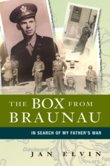
I wrote this book about my father, who served as a lieutenant in Patton's Third Army and was involved in the liberation of the Ebensee Concentration Camp. His civilian life was plagued by nightmares of combat and the camps. After his death at age 86, I read the riveting WWII diary he kept of the Allied offensive in Europe and was able to incorporate it into my book. I also interviewed family members and fellow soldiers in a rewarding but sometimes painful journey to understand the effects of post-traumatic stress disorder on my father and our family.

I hope you will be able to come - we'll have plenty of time for questions afterwards. There will be books available for purchase and signing also.

Here are just a few of the recent comments I've gotten about the book:

"I was so moved by your scholarship, sensitivity, persistence, insight and wisdom...it had a profound impact on me."

This was from a man whose father-in-law had suffered from dementia for many years: "Thank you so much for the investment of time, talent, and resources you committed to your recent book "The Box from Braunau." You so aptly and appropriately lifted the shadow from the experiences my wife's father had with your father in the 80th Division. Your research has filled a void, for which we are most grateful."

As a postscript to my last blog about Max Cleland, I want to make sure I report that he is doing very well now. Settling into his job as Secretary of the American Battle Monuments Commission, his ptsd symptoms have waned significantly. He commutes between Washington and his home in Atlanta so he can check on and care for his 96-year old father.

The above photo was taken at my talk at Politics and Prose Bookstore in Washington, DC last year.

Monday, January 4, 2010

Max Cleland, Patriot


I just finished reading Heart of a Patriot: How I Found the Courage to Survive Vietnam, Walter Reed and Karl Rove, by former United States Senator and Veterans Administration head Max Cleland. In this moving and often heartbreaking book, Cleland chronicles his life's struggles after being left a triple amputee by a grenade explosion in Viet Nam. Over and over again, he picks up the pieces of his life and his psyche, and rises to "stand tall" among his fellow citizens. He gives his life to public service and becomes the first Vietnam veteran to serve in the Georgia State Senate, then serves as head of the Veterans Administration under Jimmy Carter. Eventually he fulfills his dream of becoming a U.S. Senator.

But during the campaign for his reelection, he was singled out by Republicans as being — incredibly — "unpatriotic." The shattering loss brought on his latent Post-Traumatic Stress Disorder. As a result, Cleland returned to Walter Reed Army Medical Center for treatment and, as he says, "cried for two and a half years."

Last year President Obama appointed him Secretary of the American Battle Monuments Commission, which manages the 24 overseas cemeteries where American soldiers are memorialized. I imagine those soldiers would be proud to know that someone with Max Cleland's courage and depth of character is in charge.

Wednesday, December 9, 2009

The U.S. Supreme Court, the Death Penalty, and PTSD


The U.S. Army's "suicide crisis" has brought needed attention to the issue of post-traumatic stress disorder among soldiers.

As of November 16, 140 active duty soldiers and 71 non-active duty soldiers had killed themselves. The rise in both suicides and incidences of PTSD appear to be linked.


On November 30, the Supreme Court of the United States gave hope to a Korean war veteran sentenced to death in Florida. George Porter returned from Korea a traumatized and changed man, the Court said in its opinion. He suffered from PTSD as a result of his battle experience, yet his lawyers never brought it to the attention of the jury at trial in 1988.


As a result, the court held, the representation provided Porter fell below minimum Constitutional standards. The justices seemed to say that if members of the jury had been informed of his service in combat and resultant trauma, they might have spared his life.


The Washington Post reported that the justices of the Supreme Court were "strikingly sympathetic" to Porter, who shot his former girlfriend and her new boyfriend 13 years ago.


The justices highlighted Porter's PTSD, saying, "Our nation has a long history of according leniency to veterans in recognition of their service, especially for those who fought on the front lines as Porter did. Moreover, the relevance of Porter's extensive combat experience is not only that he served honorably under extreme hardship and gruesome conditions, but also that the jury might find mitigating the intense stress and mental and emotional toll that combat took on Porter."

TheSupreme Court cast no doubt on his guilt, but sent the case back to the U.S. Court of Appeals for the 11th Circuit.


Linda Greenhouse of the New York Times said that "the most notable feature" of the opinion "was the sympathy that all nine justices displayed for a man who, in the fullness of his adulthood and after promising a friend that she would soon be reading about him in the newspaper, stole another friend's gun and shot two people to death in cold blood." Opinionator.blogs.nytimes.com/category/linda-greenhouse/

The Court seemed to go out of its way to show that it takes PTSD seriously. What do you think?


Wednesday, November 25, 2009

New Resource for Families Dealing with War Trauma


My Story: Blogs by Four Military Teens

This is helpful information for the teenager in the family — a group we often ignore when discussing the struggles of the returning combat veteran. It's a book written by Michelle Sherman, a clinical psychologist in Oklahoma, who specializes in supporting families affected by PTSD/trauma

Dr. Sherman wrote it primarily as a source of support and education for military teens, but also as a tool to educate civilian youth about the military family experience.

This is especially important now because the military is so isolated from the rest of society. It's very different from World War II, when a teenager was almost sure to find others on the block who had a family member involved in the war effort.

Although the four young bloggers in the book are fictional, the stories are real ones taken from the lives of teens Dr. Sherman actually knows.

The four kids blog about:


  • Pride in parent's military service
  • Confusion, anger and sadness over deployment
  • Challenge of reconnecting after homecoming
  • Finding a "new normal"
  • Divorce
  • Teen depression
  • Excitement of homecoming
  • Dealing with parent's emotional and physical challenges post-deployment
  • Resilience and post-traumatic growth


See the website
www.SeedsofHopeBooks.com for more information.


Monday, November 2, 2009

"How do your siblings feel about your book?"


I'm often asked, "How do your siblings feel about your book?"

My older brother plays an important part in my book, just as he has in my life. He recently blogged about what it's like to be in a book (mine), and he picked up on one of the most important things I learned while writing:

Each sibling has a different childhood. We might live under the same roof with the same parents, but we arrive at different times in our parents' lives. All sorts of things change in the time between our births: the stresses vary, the income fluctuates, and the temperature of the marital relationship rises and falls.

My brother John (to whom I refer in the book as "Jay," his boyhood nickname) would have written a much different book— an angrier book— he says. We both recognize that it's my perspective, not his or anyone else's, that appears in The Box from Braunau.

However you look at it, my brother is one of the most interesting and engaging people I know. He's always digging into a mystery. John's a guest columnist on the website of America's premier cultural prankster, Joey Skaggs, where his LiteratEye column appears on Fridays. He also maintains a news blog on literary deception. If you're intrigued by literary fraud, or if you want to see what John says (scroll down to #34) about being in my book (or any book), check out his posts.

Monday, October 19, 2009

Five things I wish I'd asked my father about World War II


Five years after my father died, I finished my book about Dad's experiences during World War II. I had spent a lot of time holed up in libraries, museums, and places like the National Archives doing research about the war. He'd left a journal of his time in combat, excerpts of which are contained in the book, but I wanted to make sure I properly filled in the blanks left by the journal. I delved into the history of battles, the strategy, and dusty old records of the 80th Infantry Division.

I was able to answer many of the questions I had about his military service. And since Dad and I had a few conversations about the war in the year or so before he passed away, I was able to get more information about his personal experiences.

But in truth, writing the book after his death raised many more questions than it answered. Learning about the battle plans, the After Action Reports, and all the dates and times regarding his war made me want to know how he'd felt about it. So as Father's Day approaches, I decided to pull together five things I wished I'd asked my father about World War II, things only he could answer. Doesn't hurt to ask.

These are a few questions I might have asked him over a warm cup of coffee, sitting on the couch one morning, or over a beer down at the pub. I'm going settle in with a cup of coffee now and pretend Dad is sitting with me. I'll start with the questions in a gentle manner, since he didn't like to talk about this subject very much:

— Who was your best friend during the war?

I know that in your war journal you mention Graham quite often. He was a friend from your hometown of Frostburg, Maryland but he received a serious head wound not long after you entered battle in France, and was sent home. After that, who, if anyone, took his place? Did you have another best friend?

— Describe two incidents, one humorous and one serious, that you remember most vividly from the war.

— How did you deal with fear?

I know from your journal that you were very frightened during some of the artillery shelling and thought you were going to die more than once. Were you ever scared enough to think about running the other way? And I often wondered, what keeps soldiers from doing that?

— What was it like to come home?

And what might be more interesting, and surprising — what was it like six months later? Was it hard to adjust over the longer term?

— Lastly, I want to ask about Ebensee, the terrible concentration camp

I know now that you went to this camp and observed it only days after it was liberated by your Division. You had nightmares for years and suffered from your memories of that camp. You even said that it was far worse than anything you'd seen in combat. But did you ever talk about it before I asked you about it five years ago?

Anyone who has the chance to sit on the couch somewhere with a veteran, particularly a veteran of the Second World War, might try asking some questions. It will probably lead to an interesting conversation, and one you'll be glad you had. So grab that cup or coffee (or glass of beer), and don't forget the tape recorder.

Thursday, October 8, 2009

"The Greatest Generation" is Sometimes Uncomfortable with the Title


My friend George Anderson is proud of his service in the 318th Infantry Regiment in World War II but he is not fond of the term "Greatest Generation." George says that today's generation — or any generation — would perform comparably to his in wartime, and that we should let all our veterans know that we honor them and appreciate their service.

I thought of World War II veterans like George and my father when my friend April Moore sent me a link to a wonderful article called "High-Five Nation," written by David Brooks in the New York Times.

"It made me think of your dad," she said.

After reading it, I wondered if the soft spot we have in our collective hearts for that generation might come, not just from our admiration of the sacrifices they made and the success they ultimately had, but from our appreciation for their humility. See it on Andy Schmookler's blog at www.nonesoblind.org/blog?p=4174/

Wednesday, September 30, 2009

Role of Women in Wartime: Today vs. World War II


That's a huge topic, and not one that I'm going to tackle at the moment. But I do want to explore the role of women in one regard: the soldier's return home. I spoke at Politics and Prose (our wonderful local bookstore) recently and talked about how my mother and many other women had dealt with the joys and difficulties of that reunion in 1946. A member of the audience rose and asked, "How different is it now, with women soldiers returning from a war zone, sometimes to a family with young children - children who may not remember their mothers any more than your brother remembered your father when he returned from overseas?" What a great question. If any of you can shed light on this subject, please contact me at info@janelvin.com or leave a comment here. I'd especially like to talk to any women who have been deployed to Iraq or Afghanistan and have returned home to family.

And I'd like to thank to Jenny Andrews from www.notalone.com for her help. The site is a great resource, devoted to helping the community of military men, women and families to face the challenges of coming home.

On other fronts, I will be giving a talk about The Box from Braunau: In Search of My Father's War and signing books tomorrow night, October 1, in Ellicott City, Maryland at the Howard County Library, Miller Branch. You can call to sign up and get directions 410/313-1950, or go online to www.hclibrary.org to sign up. (It's not necessary to sign up in order to attend, but it helps them figure out how many chairs to put out!)

Thursday, October 1, 2009 7 p.m. Howard County Library Miller Branch 9421 Frederick Road Ellicott City, MD 21042

Photo above: My mother, Jane Elvin, showing me Raggedy Ann, early 1947.

Wednesday, September 9, 2009

Need Your Feedback on Women in Military


In this blog, I'm issuing a request:

Do you know any women in the military who would be willing to be interviewed? I'm particularly interested in finding a woman who's been deployed to a combat zone and has had to leave a family behind, and who's willing to talk about her experience upon returning home.

The photo above is of my parents and my older brother, shortly before my father left for France in 1944, where he fought in General Patton's Third Army. In The Box from Braunau: In Search of My Father's War, I outline some of the problems our family faced upon his return and in ensuing years. I am curious to hear how different that might be for women who return now from Iraq and Afghanistan.

If you are interested, please send me an email at info@janelvin.com, either to tell me your story or perhaps to tell me about someone you know. Thanks so much for any help and feedback on this! I'll keep you posted on what I find out.

Saturday, September 5, 2009

Summer Break Almost Over...

I'll be back, as Ahnold said.

I've been traveling, to wonderful San Francisco and to the Delaware beach for some summer family time, and to Pittsburgh for the 90th Reunion of the 80th Infantry Division.

I'll have more to say about the Reunion next week, when I'm back at work. I hope to see you then!

Wednesday, July 29, 2009

The Box from Braunau Starts a Conversation


Last week I drove 50 miles north to pay a visit to Clayton Warman and his wife, Anne. Clayton is a decorated veteran of World War II who served alongside my father in Patton's Third Army, the 80th Infantry Division. I met him while working on the book, and we quickly became friends.

We settled in to catch up in his comfy living room that looks out on the Catoctin mountain range, and Clayton told me this story:

His granddaughter had stopped by the previous evening, just to say hi. My book, The Box from Braunau was on the floor by her chair. She saw it and asked her grandfather if he knew the soldier whose photo graced the cover. He said yes, he had known my father during the war.

Had I written about Clayton in the book? she asked then. When he said I had, she wanted to read it.

Over the course of the next three hours, she drew him into a conversation about the war - not only his personal stories and his feelings about going to war, but the wider implications regarding the political situation that led up to it.

My book got them talking. Clayton told me that none of his grandchildren had ever asked about his experiences during World War II before. He seemed happy that the book had opened the door to a new conversation with his young granddaughter.

Saturday, July 18, 2009

Women Veterans Are More Apt to Become Homeless


Men - they certainly took up most of the space in my book about my father and his experiences in World War II. The fighting Army then was made up entirely of men, with women occupying the more supportive roles. Of course, times have changed now, and women are part of the fighting force in Iraq and Afghanistan. Here are some startling and disturbing statistics about women veterans and homelessness, offered by Bryan Bender, of the Boston Globe (July 5, 2009). This came to me via Ilona Meagher's terrific blog.

"As more women serve in combat zones, the share of female veterans who end up homeless, while still relatively small at an estimated 6,500, has nearly doubled over the last decade, according to the Department of Veterans Affairs. For younger veterans, it is even more pronounced: One out of every 10 homeless vets under the age of 45 is now a woman, the statistics show. ...

"Overall, female veterans are now between two and four times more likely to end up homeless than their civilian counterparts, according to the VA, most as a result of the same factors that contribute to homelessness among male veterans: mental trauma related to their military service and difficulty transitioning into the civilian economy. ...

"According to the National Coalition for Homeless Veterans, a nonpartisan advocacy group in Washington, about 23 percent of the homeless population in the United States are veterans. Nearly half are from the Vietnam era and three-fourths experience some type of alcohol, drug, or mental heath problem. Most of the homeless vets, who are estimated by the Veteran’s Administration to number at least 130,000 on any given night nationwide, are men older than 50.

"With a new generation of veterans from Iraq and Afghanistan leaving the armed forces, however, the demographics are swiftly changing. And with more women serving on active duty - a full 15 percent of the military is now female - the share of female homeless veterans has grown from about 3 percent a decade ago to 5 percent, according to the VA."


There are more problems for women veterans. The Government Accounting Office (GAO) issued a report recently detailing significant barriers faced by women veterans when trying to access VA care. You can read more about this on the Iraq and Afghanistan Veterans of America (IAVA) website. This group works hard for the welfare of our veterans.

Wednesday, July 8, 2009

Box from Braunau Resonates with Baby Boomers


Thank you for coming to read my blog. In the weeks since The Box from Braunau came out, I've noticed that much of the interest in it comes from other baby boomers, that is, people whose fathers may have served in either World War II, or the Korean War. They want to touch the past, to understand their own father's war, or to fill in the gaps in their family history. The Box from Braunau has had an impact on them. Here are some of the comments readers have made:

"Your book and some of the similarities moved me immensely...The timing in your story and mine are different, some of the key characters rearranged, but at many points I felt like I was reliving some of my early angst through you. It has had a profound effect on my and I will have to put this on my list of all-time favorite books."

"I think there's much in the book that can touch a lot of people, not just those with fathers who 'went to war.' Don't we all, when we're older, wish we'd taken the time to talk more to our parents, find out who they really were - you actually followed through on that."

"I read your blog and was struck that our journeys to understand our fathers' war seem to be on parallel tracks. I think there must be countless baby boomers who are on the same path..."

"I connected with your story because of my own experience. My guess is that you hear from a lot of people about how the book helped them better understand their own fathers' experience.

"I am overwhelmed by your generosity in helping me find some piece of this big huge puzzle I've opened.

"My father was a bomber pilot in WWII. THis book helped me better connect to his era and understand why his war experience as a young man made such an indelible impact on the rest of his life."

"You are taking a great step in the healing work that continues generations after WWII."

Thanks to all readers for the comments so far. I would love to hear more from you. Share your stories with me by leaving a comment here!